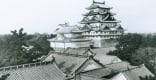
Main Gate (reconstructed)

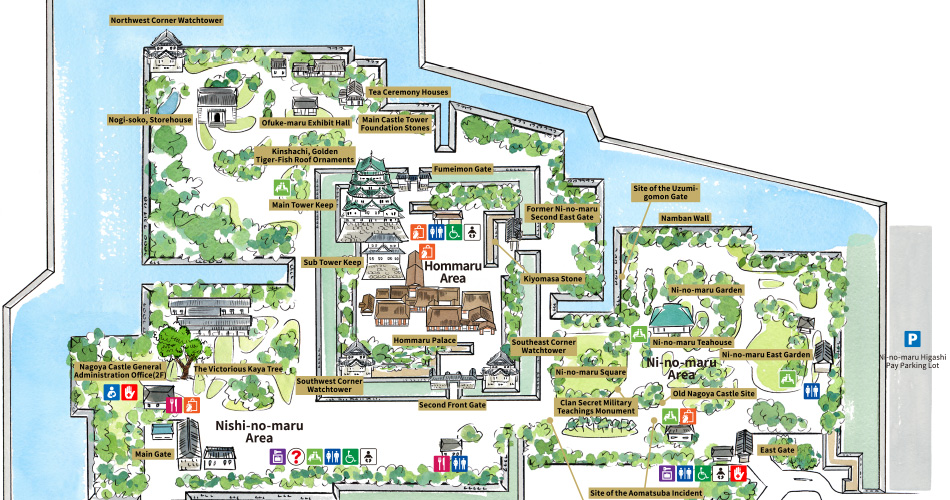
This gate was originally called the Nishinomaru-enokida Gate. It was destroyed by fire during the Second Word War. The gate was reconstructed together with the donjon in 1959.
Omote-ninomon Gate (Important Cultural Asset)

This gate was formerly called Minami-ninomon Gate. The gateposts and the roof are all covered with steel sheets. The gate is solidly constructed of thick timber.
Japanese Nutmeg

Kaya-no-ki or Japanese nutmeg is a protected species. This tree is said to be more than 600 years old.
Northwest Tower (Important Cultural Asset)

Also called Inui Tower or Kiyosu Tower, the Northwest Tower is a three-story structure with a roof at each level. The top layer, designed in the “irimoya” style, is covered with tiles.
Many materials taken from other structures were also used in building this tower.
Nogi Warehouse

This warehouse is a modern one-story brick building with plastered walls. It is located at Okefumaru in the Nagoya Castle and not opened to the public.
The warehouse was built as an ammunition depot of the Imperial Japanese Army after the whole Sannomaru area of Nagoya Castle was placed under their control in 1874 following the deployment of a garrison in the castle in 1872. The actual time of construction is unknown.
The size of the warehouse is 89.25 square meters, 12.28 meters from east to west, 8.6 meters from north to south, and 7.68 meters in height. The size of the ancillary gunpowder depot is 13.12 square meters. The building is characterized by the arch structure found at the entrance and the underfloor area, as well as the colored plaster finish in a masonry pattern found on the corners of the building. The doors are covered with copper sheets.
The Nogi warehouse is said to be named after General Maresuke NOGI of the Imperial Japanese Army.
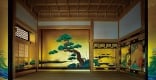
Although the Donjon, the Hommaru Palace, and other buildings were burned down by the May 14, 1945 air raids on Nagoya, during the Second World War, this warehouse survived while holding the paintings on the sliding doors and walls of the Hommaru Palace, which had been moved and stored in this building.
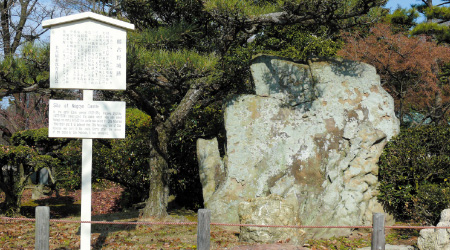
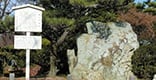
Kiyomasa’s Stone

It is said that Kiyomasa KATO, who was ordered to build the stone base of the donjon, personally “called the tune”, and made young and old alike sing the cadence while he supervised the hauling of the huge stones used in the construction.
Hommaru Palace (destroyed by fire)

Just south of the Main Castle, the Hommaru Palace was originally built to be the offices and residence for the founding Lord of the Owari Clan, Tokugawa Yohinao, and later became the living quarters for visiting Shoguns. The Hommaru Palace, along with the Ninomaru Palace at Nijo Castle in Kyoto, is considered to have been the best example of Shoin Style palace architecture. Regrettably, the Hommaru Palace was destroyed by fire during the Second Word War. (We are currently accepting donations for its reconstruction.)
Southeast Tower(Important Cultural Asset)

This tower is also called Tatsumi Tower (tatusmi refers to the south-east). This tower survived the original castle. The symbol of a hollyhock (crest of the Tokugawa family) can be seen on the ridge-end tiles.
Southwest Tower (Important Cultural Asset)

This tower is also called the Hitsuji-saru Tower (hitsuji-saru refers to the south-west). It is three stories tall with a two-level roof. On the west and south sides, trap doors projet below the lower-level rool for the purpose of dropping stones on attackers to defend the castle. The symbol of the chrysanthemum (the Imperial crest) can be seen on the ridge-end tiles.
Sword Fence

Thirty-centimeters-long spearheads are arrayed on the beam of the waves to ward off intruders.
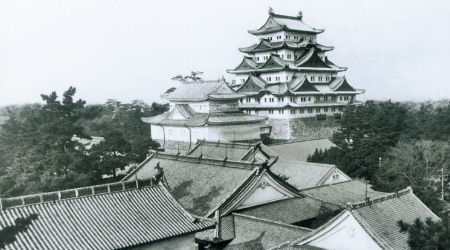
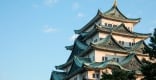
The Donjon

The original Nagoya Castle, surmounted by its resplendent golden dolphins, was burned to ashes in the Second World War. In 1959, the main donjon, the small donjon, the abutment bridge between the two, and the main gate were reconstructed.
East Ninomaru Garden

Excavation based on Oshiro Niwa Ezu (an illustration of the old castle’s garden) found the north pond, south pond, the site where the tea arbor named Soketsu one stood, and a drain. Rebuilt, the four form the main features of a 14,000m2 garden. Also in the vicinity are gardens of peonies and other flowers.
Ninomaru Tea House

The Ninomaru Teahouse is a building which expresses classical beauty through modern archintecture. It is constructed with hinoki cypress from the Kiso region. A tatami-mat room and a washing room are used in the traditional Japanese tea ceremony.
Ninomaru Garden

From 1615 to 1623, at the same time as the construction of the Ninomaru Place, a garden was laid out with a sanctuary on the north side of the palace as its centerpiece. However, in 1716, the garden was transformed into a dry Japanese Landscape garden, designed to be walked through.